



Product Description
GET YOUR BOOST BACK!
Test your Honda turbo setup at the turbo inlet and find leaks fast. Most builds are losing power and don’t even know it. It just doesn't feel as fast as it used to — fix the leak and feel the boost hit like it should.
Find Leaks in Minutes
Checks your entire system with your engine off:
- Charge piping
- Intercooler
- Couplers & clamps
- Intake manifold
- sensor bungs
- injector seals
- throttle body and gaskets
- blow off valve
- wastegate
- vacuum lines & PCV
All the common leak points on boosted Honda builds.
Smoke testing is not sufficient as it only tests low pressure 1psi.
Why It Matters
Boost leaks =
- Weak pull
- Slow spool
- Lost MPG
- Turbo working overtime
Left alone → blown couplers, shaft play, or worse… turbo failure.
Test it. Most failures start with a leak.
Add an extension line kit to make the testing easier, less reaching and allows fine control for consistent pressure management, making it an easy one-man test.
Fitment
Fits 3"–4" turbo inlet / intake piping
✔️ Installs directly on your turbo inlet
Common Honda setups:
- K-Series turbo builds
- K-swapped Civics / Integras
- B-Series turbo
- D-Series turbo
- Small frame setups
Be sure to measure your turbo inlet for correct size.
Add an extension line kit to make the testing easier, less reaching and allows fine control for consistent pressure management, making it an easy one-man test.
Design Features:
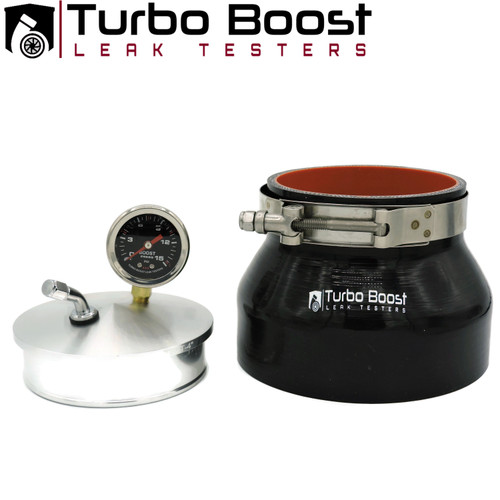
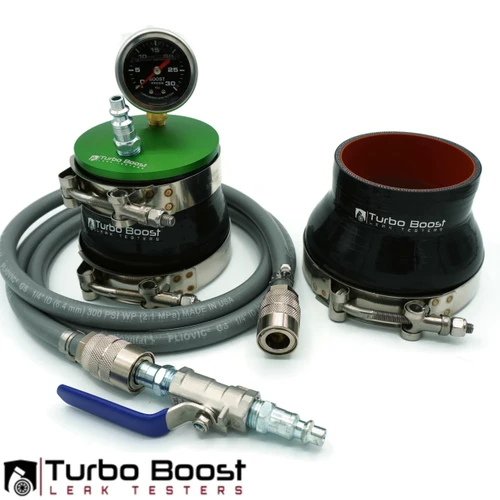
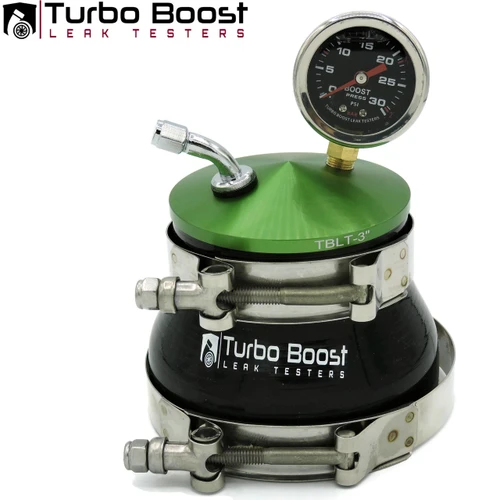
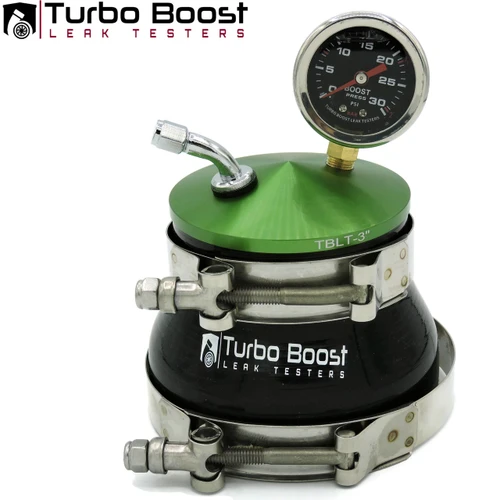
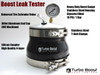
Billet 6061 Aluminum End Cap with 1/8" NPT threaded gauge port & fitting
High quality 4-layer silicon coupler
Custom Stainless Steel 15 PSI / 1Bar Boost Gauge
15 PSI range will give you the appropriate reading when testing your charge pipes for low, medium or high boost levels.
Universal Tire Schrader Valve
(2) Stainless Steel T-Bolt Clamps with Teflon lock-nut
Option to add an Extension Hose Kit:
Will allow control over shop air and manage the pressure entering into your turbo system. Mandatory for shop environment where the air compressor is inaccessible. The ball valve lets you turn on and off the pressure into the system - this can be very important for you to check the decay or bleed rate after filling the system with pressure. The bleed rate lets you know how well the system holds and this can only be done by cutting off the pressure to the tester.+$35 - Add 3ft Extension Hose with Shut-Off Valve
- (1) 3 ft. extension hose with stainless on/off valve for easy control
- All 1/4" NPT Fittings M-Type
- stainless steel ball valve housing
+$45 Add 5ft Ext Hose w/150 PSI Regulator & Shut-Off Valve
- (1) 5 ft. Continental extension hose with stainless on/off valve for easy control
- All 1/4" NPT Fittings M-Type
- (1) 150 PSI Air Regulator for added safety and control for shop air - aluminum housing
- Self purging regulator when turning the pressure down
- stainless steel ball valve housing
Importance of the boost Gauge?
Not having a gauge readout on a boost leak test is similar to filling air in your car's tire without a gauge. You just don't know how much air is in the system!
It is very wise to know how much pressure is actually going into the charge system to prevent damage to your engine and to yourself - Example if the compressor is unregulated (using high pressure shop air at 90 PSI) there is a risk that the charge pipes will be over-pressurized and something will give - the boost leak tester could blow off or any component of the engine could.
Simple Steps to Use the Boost Leak Tester:
- Remove the intake hose/pipe off your turbo chargers inlet
- Install the boost leak tester onto the turbo chargers inlet and secure with the T-bolt clamps
- Pressurize the boost leak tester with an air compressor and a tire inflation tool. The air compressor should be a minimum of 2 gallon volume. The larger the compressor, the more capacity you have to fill the engines charge pipes. A bike pump or electric pump will not supply enough air fast enough to fill the system
- *Caution! - When filling the system, start with a low pressure around 5 PSI. Recommended to regulate the compressor to a lower pressure and only increase if filling is too slow. The boost gauge reading indicates how much compressed air is in the charge pipes. The boost gauge allows you to read the bleed rate of charge pipes when you remove the pressure. It is normal to see pressure loss average of 1psi every second. Faster bleed rate at higher pressures and slower bleed rate at lower pressures
- Listen for leaks. Use soapy spray if necessary to identify smaller leaks.
- Fix any leaks points and then retest. Increase by 5 PSI up to the normal operating boost pressure.
- Go out and Boost! Enjoy the restored power from your engine!
The gauge on the boost leak tester allows the user to:
- apply a safe amount of pressure to prevent injury or damage to the charge pipes or engine
- read how fast the system holds and bleeds air after removing the air source
- give a good comparison of compressor outlet air Vs. boost test air while pressurizing. The smaller the difference the lesser the air loss in the system