
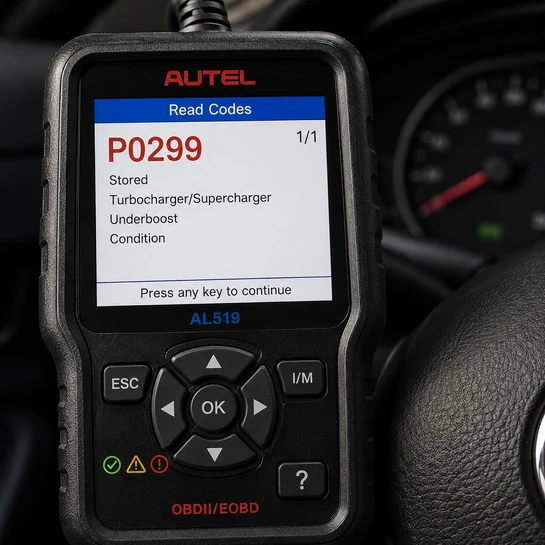
If your vehicle just threw a P0299, you’re dealing with a turbo underboost condition—and it’s one of the most common issues on turbocharged engines.
In real-world diagnostics, the majority of P0299 cases come down to one thing:
Boost leaks.
This guide will show you exactly:
- What causes P0299
- How to diagnose it correctly
- How to fix it fast (without wasting money replacing parts)
The most common cause? Boost leaks.
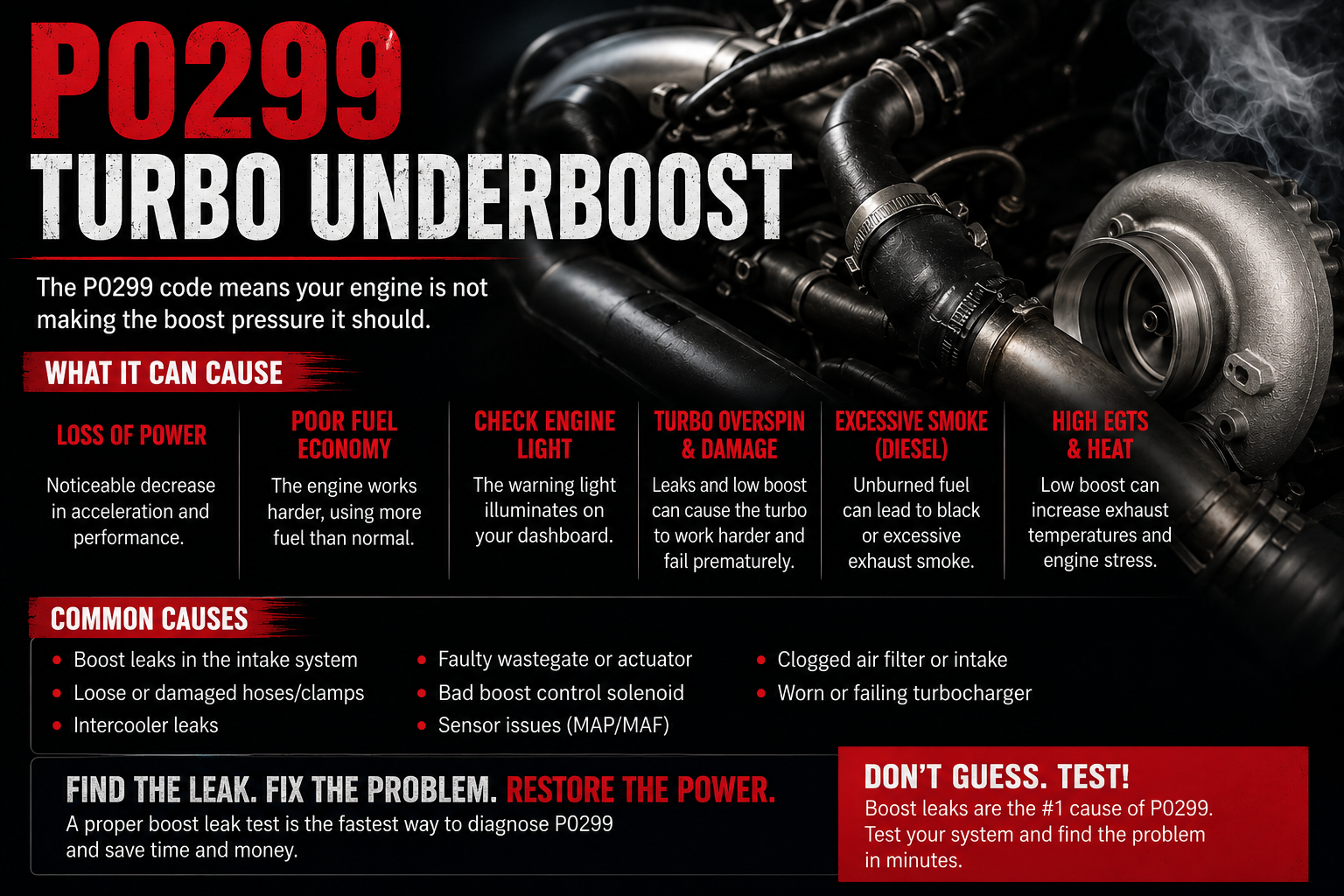
Most P0299 issues are caused by boost leaks—the fastest way to confirm is a proper boost leak test.
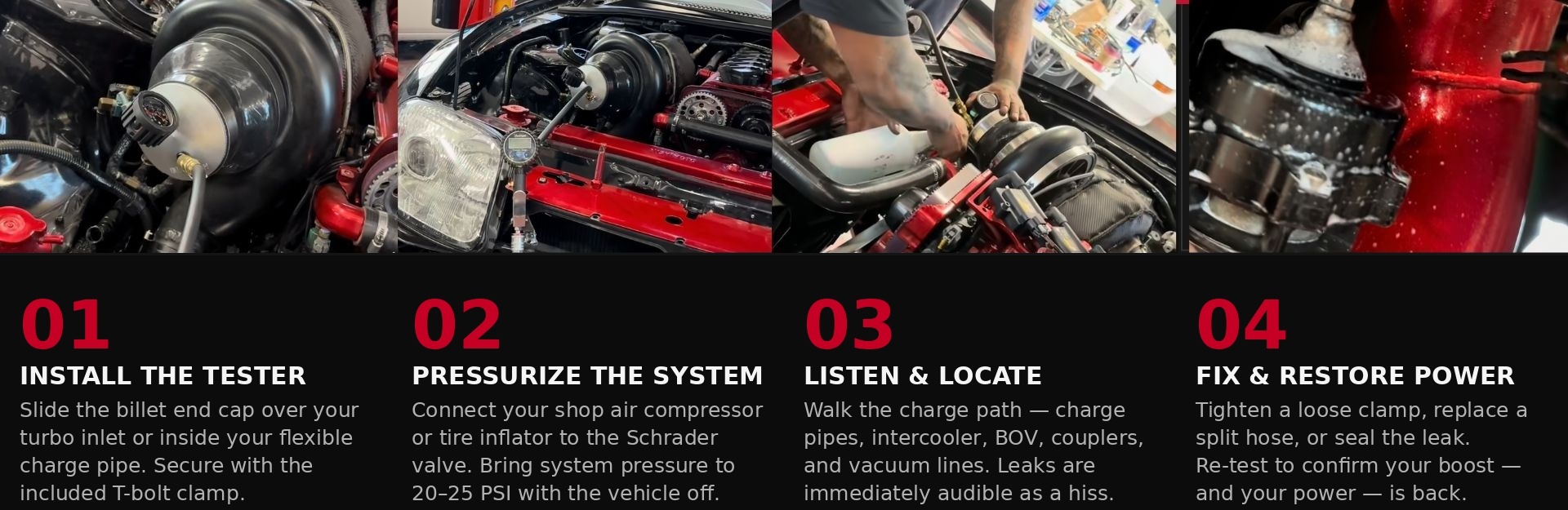
How to Perform a Boost Leak Test (Step-by-Step)
What Does P0299 Code Mean?
The P0299 means your engine is not achieving the boost pressure it expects.
In simple terms:
The turbo is working—but the pressure isn’t reaching the engine.
Common Causes of P0299
1. Boost Leaks (Most Common)
- Loose clamps
- Split couplers
- Cracked intercooler
- Leaking charge pipes
This is the #1 issue we see in testing.
2. Wastegate / Actuator Problems
- Stuck open
- Not sealing properly
3. Failing Turbocharger
- Shaft play
- Worn bearings
- Damaged compressor wheel
4. Boost Control / Sensor Issues
- MAP sensor
- MAF sensor
- Boost solenoid
Even small leaks can:
- Kill performance
- Reduce MPG
- Cause turbo overspin
- Lead to failure
Symptoms of a P0299 Code
- Loss of power
- Slow turbo spool
- Poor throttle response
- Increased fuel consumption
- Smoke (especially diesel)
- Check engine light
The Biggest Mistake People Make
Most people immediately replace:
- Turbochargers
- Sensors
- Expensive components
❌ Without ever checking for leaks first
This leads to wasted time and money.
The Correct Way to Fix P0299
Start with a boost leak test.
This allows you to:
- Diagnose the entire system in minutes
- Find leaks instantly
- Avoid unnecessary parts replacement
Fix It Fast Without Guessing
Instead of chasing parts, test your system properly.
Our in-house engineered testers are designed to:
- Work across multiple turbo sizes
- Seal properly under pressure
- Help you locate leaks fast
Recommended Tools:
- Full Shop Kit (2"–4") → https://www.amazon.com/dp/B07HCMM3XG
- 4–6" Kit for larger turbos → https://www.amazon.com/dp/B0D9NQC1V7
- Extension line kit → https://www.amazon.com/dp/B0BS9C4TSS
Preventing P0299 in the Future
- Test after installing performance parts
- Check clamps and couplers regularly
- Never tune a car with a boost leak
- Make boost leak testing part of maintenance
Final Thoughts
The P0299 is one of the most common—and most misdiagnosed—codes in turbo vehicles.
Most of the time, the fix isn’t a new turbo…
It’s finding and fixing a leak.