

The charge air cooler (CAC) cools the air coming out of the turbo before it reaches the engine. It sits out front where it takes heat, vibration and road debris every mile, so it's one of the most common places for a diesel to lose boost.
A leak makes the turbo over-spin to make up for the lost pressure. That strains the turbo, and a leak that starts small can turn into a blow-out. The good news is that a CAC is easy to test in the shop or in the yard. Here's how.
Signs Your Charge Air Cooler Is Leaking
- Lower fuel economy
- Loss of power and torque, especially pulling a load
- Whistling noises under boost
- A boost gauge that fluctuates
- An oily film around the end tanks or hose connections
Any one of these is worth a test. Even picking up half a mile per gallon adds up fast over the miles a truck runs.

What You Need
- A charge air cooler tester with two plugs, one for each end of the cooler
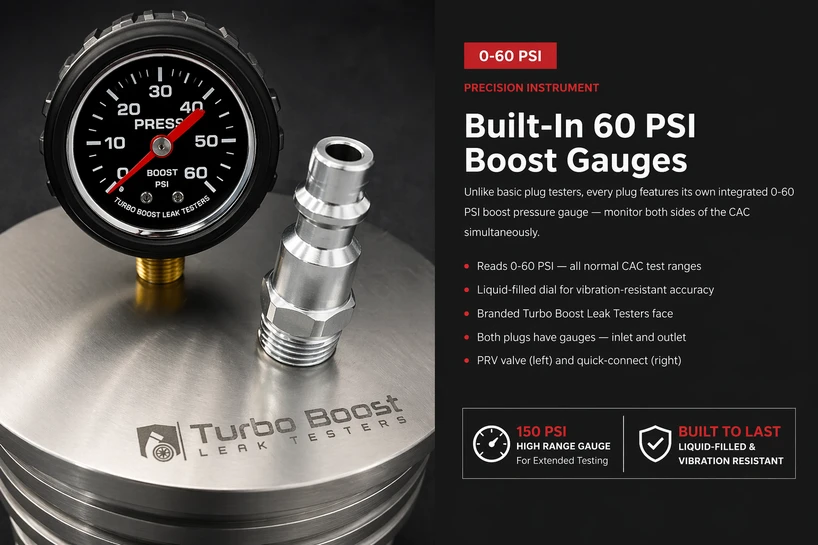
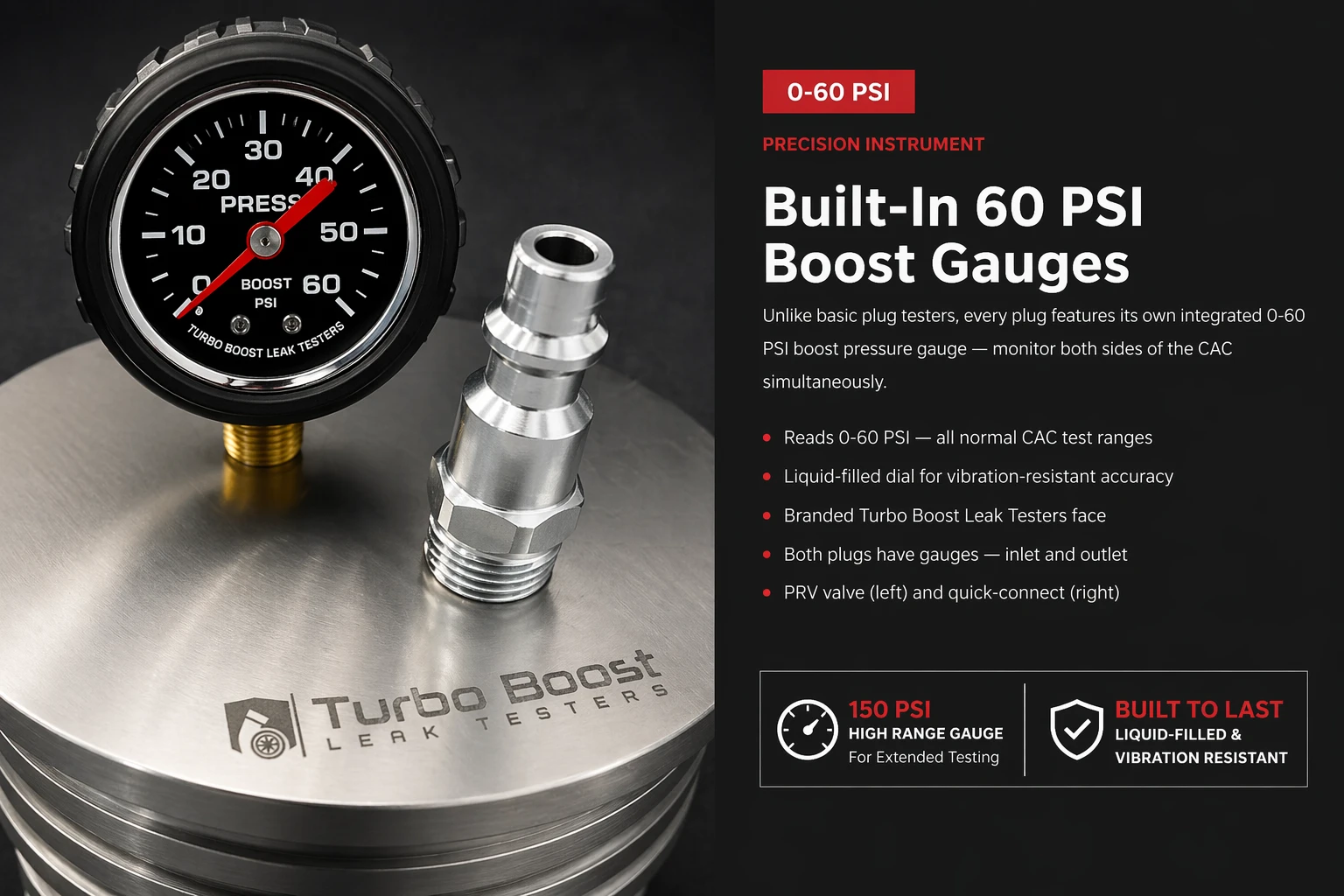
- A gauge on the tester so you can see the pressure in the cooler
- Shop air with a regulator and a shut-off valve
- A spray bottle of soapy water
- Safety glasses
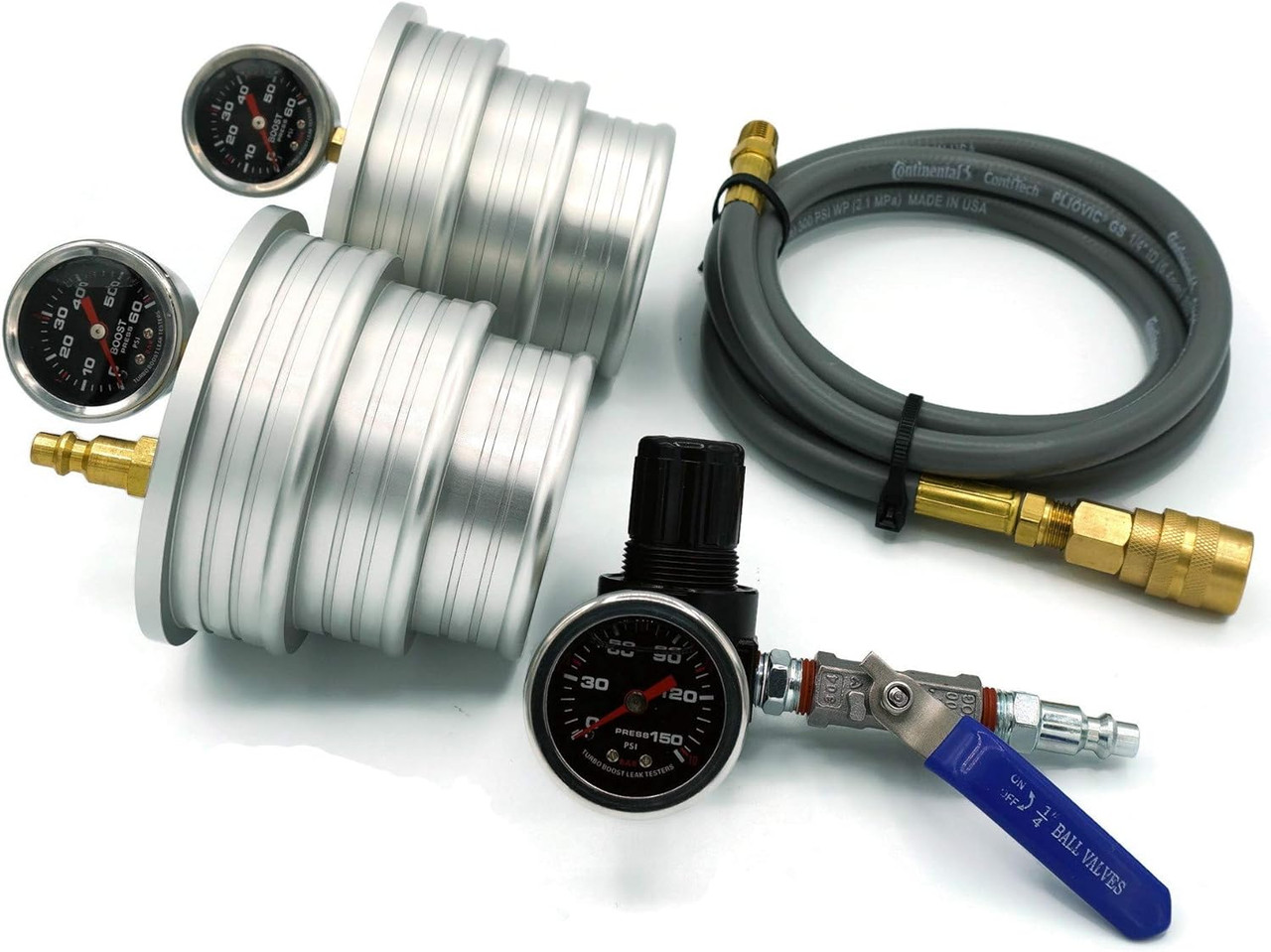
Our Charge Air Cooler (CAC) tester kit has all of it: two billet aluminum end caps stepped to fit 3", 3.5" and 4" hoses, a 60 PSI gauge on each cap, a pressure relief valve, a 5 ft extension hose, a stainless shut-off valve and a 150 PSI regulator with its own gauge.
How to Pressure Test a Charge Air Cooler
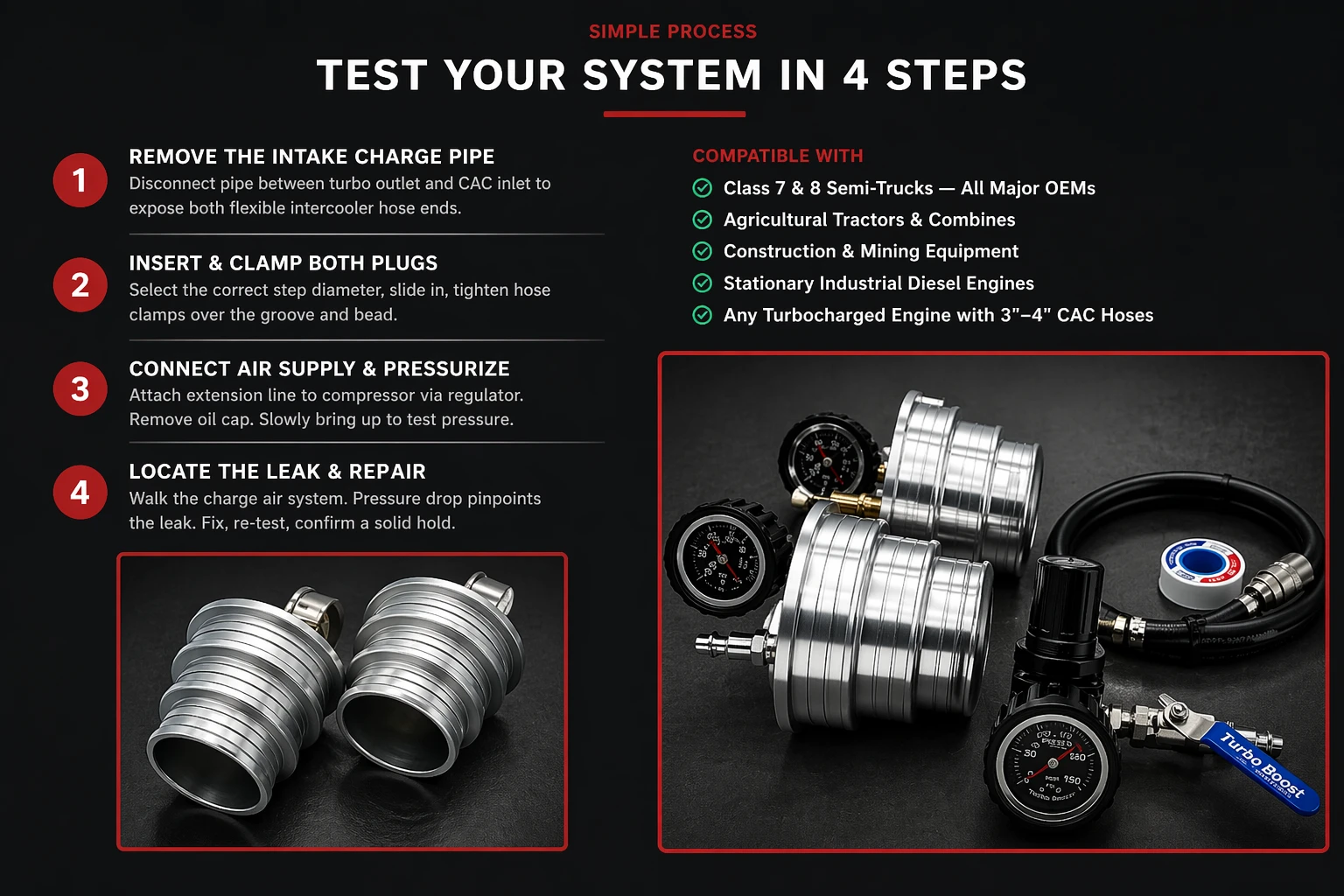
- Let it cool, then pull the charge pipes. Disconnect the hoses from both the inlet and outlet side of the cooler.
- Plug both ends. Fit an end cap into each hose or opening and clamp it down. Make sure both are secure before you add any air.
- Set the regulator to zero. Lift the cap on the regulator and turn it counter-clockwise until it stops. Close the shut-off valve by turning the handle sideways, across the air line. The arrow on the bottom of the regulator shows the direction of airflow.
- Connect shop air and build to 5 PSI. Open the valve slowly and watch the gauge on the tester. Listen for leaks.
- Fix what you find, then go higher. Repair or replace what's leaking, retest, and work up to 10 PSI, then 15 PSI.
- Shut the valve and watch the needle. With the air trapped in the cooler, the gauge tells you how well it holds. Spray soapy water on the seams and connections to find small leaks you can't hear.
- Let the air out before you pull the plugs.
What Counts as a Pass?
A cooler in good shape holds pressure. With the valve closed, the needle should sit still for a few minutes.
The tester can reach 60 PSI, but you don't need to test to that limit.
Where Charge Air Coolers Usually Leak
- Seams where the end tanks meet the core
- Tubes in the core that have cracked or been hit by debris
- Hose connections and clamps on the inlet and outlet
- Split or worn charge air hoses and boots
A leak at a hose or clamp is a cheap fix. A leak in the core or the end tank seams usually means a new cooler.
Test the New One Before It Goes In
If you're replacing a cooler, pressure test the new one on the bench before you install it. It takes a few minutes and saves you from pulling it back out.
Test the Whole Charge System
The cooler is only one part of the path. Add a 3", 3.5" or 4" silicone adapter and one of the end caps becomes a turbo boost leak tester. That lets you pressurize from the turbo to the engine and check the charge pipes, every clamped connection, the EGR and the intake manifold in one test.
Safety
- Always wear eye protection when using compressed air.
- Make sure every connection is secure. A loose plug or fitting can become a projectile under pressure.
- Start low. Build pressure slowly and never connect unregulated shop air.
Get the Tester
Our CAC tester fits Class 7 and 8 trucks from all major OEMs, plus tractors, construction equipment and stationary diesel engines with 3" to 4" CAC hoses.
Questions? Text us at 248-403-8512. Order by 5pm PST Mon–Fri or 2pm PST Sat and it ships same day!