
It's the question we get more than any other: how much pressure do I put in? Too little and you won't find the leak. Too much and you can pop a coupler off, or put stress on parts that never see that pressure on the road.
The short answer: start at 5 PSI, work up 5 PSI at a time, and stop at the boost your engine normally makes. Here's how to do it, and what the gauge should be telling you.
The Short Answer
- Start at 5 PSI. Listen for leaks before you add more.
- Work up in 5 PSI steps. Stop at each step, then listen and feel around every coupler and clamp.
- Stop at your normal boost. The rule of thumb is to not go past the most boost your engine makes while driving.
You'll catch the big leaks first. Don't stop there. Fix the leak and retest, because there may be another one that only shows up at higher pressure.
Why Not Just Crank It Up?
A boost leak test is meant to copy what the turbo does: fill the intake with the pressure it normally sees. Going past that isn't a better test. It only loads the couplers, clamps and intercooler harder than the engine ever will.
There's a safety side too. If the tester or a coupler isn't clamped down well, it can blow off under pressure. Starting low means you find that out at 5 PSI, not 25.
Typical Test Pressures
Your own boost level is the number that counts, but these are the ranges we point people to:
- Most turbo cars: work up to your normal boost. Most of our testers come with a 30 PSI gauge.
- Duramax 6.6L (LB7 through LML): start at 10 PSI and work up to 20 or 30 PSI, or whatever you normally boost.
- Charge air coolers on Class 7 and 8 trucks: build to 5 PSI, then 10, then 15. The CAC tester can reach 60 PSI, but you don't need to test to that limit.
Set the Pressure Before You Connect
Use a compressor with at least a 2 gallon tank. A bike pump or small electric pump won't fill the system fast enough. Most shop compressors are set far higher than any intake should see, so turn the regulator down first. Set the compressor to about 20 PSI to start, connect the line, and raise it only as needed.
Watch the gauge on the tester, not the one on the compressor. The tester's gauge shows the pressure in your charge pipes. If the system is filling slowly, raise the compressor pressure a little at a time and keep your eye on the tester.
If you test often, a regulator and shut-off valve at the tester make this easier. Our 5 ft extension hose kit with a 150 PSI regulator lets you set the pressure and trap it in the system without leaning over the engine bay.
No regulator? Every tester has a tire valve, so you can add air in short bursts with a tire chuck on your compressor line, then let off and watch the gauge.
Is It Normal for the Pressure to Drop?
Yes. An engine isn't an airtight tank. A small amount of air gets past an open intake valve and the piston rings, so the needle will fall once you stop adding air.
As a guide, losing about 1 PSI every second or two is normal. It drops faster at higher pressure and slows down as it gets close to zero.
What isn't normal:
- A hiss you can hear. That's a leak. Spray soapy water on the joint and look for bubbles.
- The system won't build pressure at all. Something is disconnected, or there's a very large leak.
- On a Duramax, the gauge stays at zero. Check the EGR valve. If it isn't closing all the way, the test pressure goes straight into the exhaust.
- You're testing at an intake pipe before the turbo and can't build pressure. Plug the crankcase lines on that pipe, between the tester and the turbo.
A charge air cooler tested on its own is different. It's capped at both ends, so once the leaks are fixed the needle should hold steady for a few minutes.
Before You Add Air
- Take the oil cap off. Some of the test pressure ends up in the crankcase. Removing the cap takes that pressure off the oil seals.
- Wear safety glasses and stand clear of the tester while the system is under pressure.
- Don't over-tighten the T-bolt clamp. That can make the clamp fail and the tester pop off.
Get the Right Tester for Your Vehicle
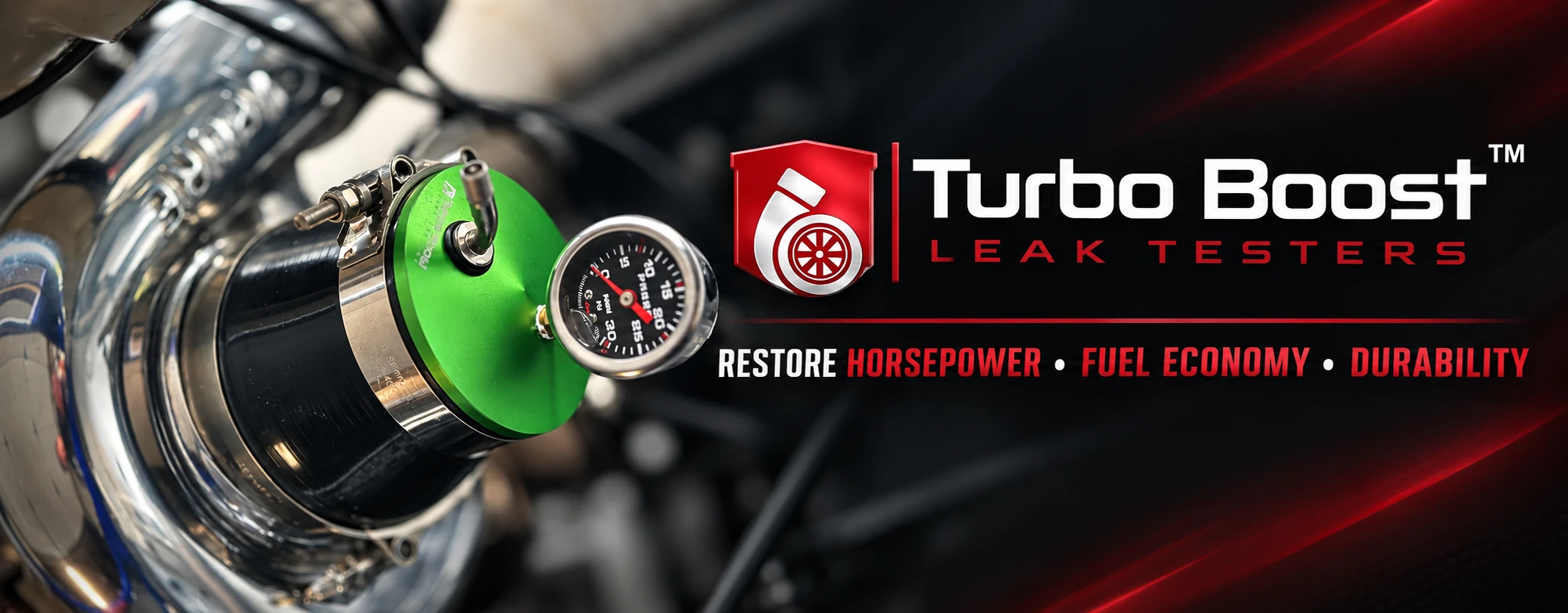
Our billet aluminum testers come with a boost gauge, T-bolt clamp, tire valve and M-type air fitting, so you can see exactly what's in the system.
Not sure what your setup needs? Text us at 248-403-8512. Order by 5pm PST Mon–Fri or 2pm PST Sat and it ships same day!