



Test your BMW single turbo N55 motor the easy way!
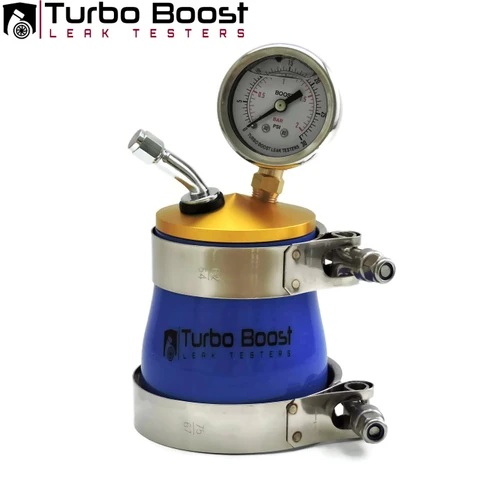
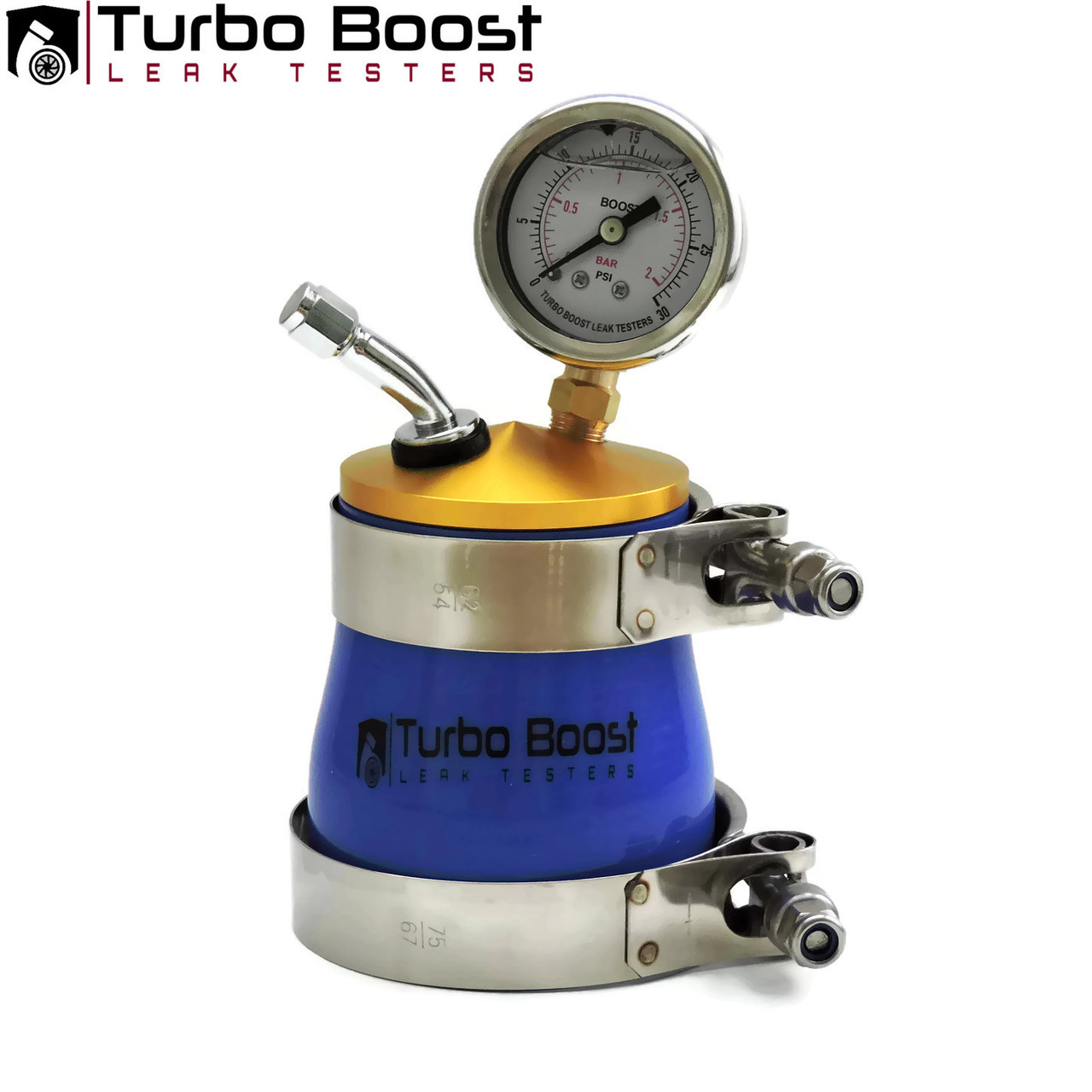
This Boost Leak Tester kit mounts the inlet pipe of your turbo that lead to your turbo's compressor inlet flanges. The turbo intake hose that wraps around the top/back of the motor is removed and the turbo inlet flange is exposed which is where you will install the boost leak tester. You'll be able to test from the turbo to the motor checking all leak points in between, including intercooler, clamped connections, throttle body O-ring, intake manifold, diverter valves and the many random potential leak points.
Note* the turbo inlet flange where you will clamp the boost leak tester on is plastic and take caution not to over-clamp the boost leak tester on this flange. That being said, use low pressure to start testing the system and work your way up to 15 PSI.
Design Features & What's Included:
- Billet aluminum CNC'd and anodized with tire valve Schrader port and 1/8" NPT threaded gauge port
- High quality silicone coupler
- Boost Gauge - Stainless steel shock-proof glycerin-filled. Range 30 PSI/ 2 Bar
- (2) Stainless Steel T-bolt Clamps with teflon lock-nut
What happens to the turbocharger if there is a boost leak?
Any leak will cause the turbo's wheels to over-spin and result in bearing to wear out eventually causing shaft play! This happens faster with larger leaks. This condition then allows for the turbo's wheel tips to make physical contact with the turbo housing. It's over for your turbo at that point!
Common Leak Points:
- Faulty charge air coolers (leaking through various cracks)
- Intake Manifold cracks
- Turbocharger outlet pipe leak
- Charge air cooler piping
- clamped connections
- diverter valve leaks from diaphragm or boost lines
How do I know if I have a Boost Leak? Common Symptoms are:
- P-codes, Check engine lights, system too rich
- Loss of power
- Poor Fuel Mileage
- Typically the boost target will be lower than what is expected by the tune
- Boost onset could be erratic
- Slower than normal spool-up
Compatible with the following models and production dates:
These all share the common turbo inlet pipe part number 13717583727. This is where the boost leak tester attaches.
| 5' F07 GT (09/2008 — 06/2013) |
| 5' F07 GT LCI (08/2012 — 02/2017) |
| 5' F10 (01/2009 — 06/2013) |
| 5' F10 LCI (08/2012 — 10/2016) |
| 5' F11 (02/2009 — 06/2013) |
| 5' F11 LCI (10/2012 — 02/2017) |
| 5' F18 (08/2009 — 07/2013) |
| 5' F18 LCI (11/2012 — 12/2016) |
Simple Steps to Use the Boost Leak Tester:
- Remove the intake hose/pipe that connects the airbox and the turbo inlet pipe.
- Install the boost leak tester onto the turbo inlet and secure with the T-bolt clamps
- Pressurize the boost leak tester with an air compressor and a tire inflation tool. The air compressor should be a minimum of 2 gallon volume. The larger the compressor, the more capacity you have to fill the engine's charge pipes. A bike pump or electric pump will not supply enough air fast enough to fill the system
- *Caution! - When filling the system, start with a low pressure around 5 PSI. Recommended to regulate the compressor to a lower pressure and only increase if filling is too slow. The boost gauge reading indicates how much compressed air is in the charge pipes. The boost gauge allows you to read the bleed rate of charge pipes when you remove the pressure. It is normal to see pressure loss average of 1 PSI every second. Faster bleed rate at higher pressures and slower bleed rate at lower pressures
- Listen for leaks. Use soapy spray if necessary to identify smaller leaks.
- Fix any leak points and then retest. Increase by 5 PSI up to the normal operating boost pressure.
- Go out and Boost! Enjoy the restored power from your engine!
Lifetime warranty on every component. Designed and engineered in the USA.
Helpful guide: How to boost leak test a BMW